
The world’s largest beaver dam is so big that you can see it from space | World News
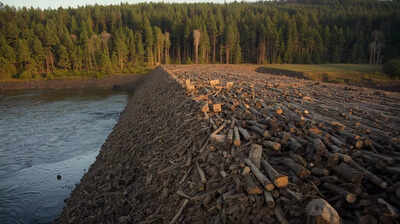
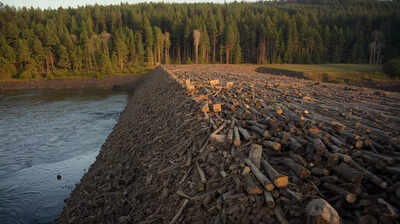
Wood Buffalo National Park in Canada, which includes northern Alberta and parts of the Northwest Territories, is home to the largest beaver dam ever documented. The structure is located deep within the park, far from roads, towns, and established paths, making it inaccessible by foot. It is so large that it can be seen in satellite photographs from orbit. The dam is approximately 775 metres long at its front edge and spans an area of around 70,000 square metres, keeping back a substantial volume of water. It was initially discovered in 2007 using satellite imaging rather than terrestrial exploration. Further investigation revealed that the dam did not exist before 1980, implying that it was developed over several decades by multiple generations of beavers operating in the same spot.
A beaver dam hidden in Canada is clearly visible from space
Wood Buffalo National Park spans northern Alberta and parts of the Northwest Territories. It is Canada’s largest national park and among the world’s largest protected places. The beaver dam is located deep within it, far from roads, cities, and recognised trails.Walking to the place would take several days. The terrain is challenging and slow. Wetlands extend over large distances. Muskeg collapses under weight. The boreal forest closes in densely. Most people who saw the dam up close did not walk there. They arrived on private sightseeing planes, looking down rather than approaching on the ground.
The actual size of the beaver dam is impressive
According to Parks Canada, from end to end, the front of the dam measures roughly 775 metres. That is close to seven football fields laid side by side. The entire perimeter of the dam area approaches 2,000 metres. Its surface area covers about 70,000 square metres.The pond created behind the dam is thought to be around one metre deep. That would place the volume of water at roughly 70,000 cubic metres. Another way to see it is through scale. A standard dump truck carries about 10 cubic yards. By that measure, the dam holds back the equivalent of more than 90,000 dump trucks of water. Seen as ice, it would fill around 1,600 hockey rinks.
This beaver dam was discovered from space
According to BBC Wildlife, no explorer stumbled across this dam by chance. No ranger logged it during patrol. It was first noticed in 2007, not on the ground, but in satellite imagery. The structure was large enough to be visible from space.Further images, including those provided by NASA, showed that the dam did not exist before 1980. That suggests it could be up to 45 years old. Over that time, it grew slowly, piece by piece, shaped by water flow and repeated work rather than a single effort. The location helped keep it hidden. With no nearby access routes, there was little reason for people to pass through.
Why beavers build on this scale
Beavers are often described as ecosystem engineers. They change landscapes by design, even if that design follows instinct rather than a plan. By felling trees and packing wood, mud, stones, and vegetation together, they redirect water and create ponds.In the case of this dam, multiple generations of beavers worked on the same structure. Each added material where it was needed. Over time, the dam expanded and strengthened, holding back runoff from the Birch Mountains at the southern edge of the park. The result is not just a barrier but an entire water system shaped by animals rather than machines.
What the dam means for the wider park
Wood Buffalo National Park is known for more than its size. It supports wood bison, whooping cranes, and the Peace Athabasca Delta, one of the largest inland freshwater deltas in the world. The beaver dam fits quietly into that setting.It supports wetlands, slows water movement, and creates habitat for other species. It does not draw crowds or require fences. It simply exists, doing its work out of sight. Even now, most people will never see it directly. The dam remains where it was built, surrounded by forest and water, changing its corner of the park a little at a time.