Operation Epic Fury: How Trump-led US strikes in Tehran killed Iran’s Supreme Leader Khamenei, family
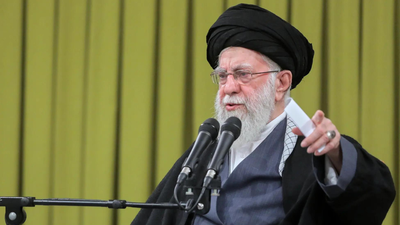
Operation Epic Fury — an extensive US military action under President Donald Trump, have achieved its most consequential objective: the killing of Iran’s Supreme Leader Ayatollah Ali Khamenei in strikes carried out early Sunday against the political heart of Tehran.According to initial reports, the operation did not only target Iran’s top leader. Khamenei’s daughter and grandchild were also said to be among those killed in the American strikes that hit key locations in the capital.Unlike last year’s Operation Midnight Hammer, aimed at crippling Iran’s nuclear aspirations at key sites, Operation Epic Fury carried out in broad daylight with a much wider strategic objective, leading to the killing of the Supreme Leader.“Khamenei, one of the most evil people in History, is dead,” Donald Trump declared on his Truth Social.The offensive marked a dramatic escalation, with Trump launching a full-scale military operation against Iran over the weekend. The move appeared aimed at dismantling the Khamenei-led political establishment and reshaping power dynamics in the oil-rich nation.However, it was not just US, but Benjamin Netanyahu-led Israel also partnered American strikes with his military muscle showcasing under the name – Operation Lion’s Roar.
A daylight strike at the centre of power
Modern aerial bombardments typically begin under the cover of darkness, exploiting confusion and weakening air defence response. This time, however, the strategy appeared deliberately different.Missiles and bombs began striking Tehran in broad daylight, a calculated move that seemed designed to ensure the presence of senior officials in government offices. Thick plumes of smoke soon rose over the capital, particularly from buildings located in the city’s political and administrative district.The strikes reportedly hit areas along Pasteur Street, where key institutions of the Iranian state are clustered. The district houses the offices of the Supreme Leader, the presidential complex of Masoud Pezeshkian, the national security headquarters, and the Assembly of Experts, the powerful clerical body responsible for appointing a new supreme leader.
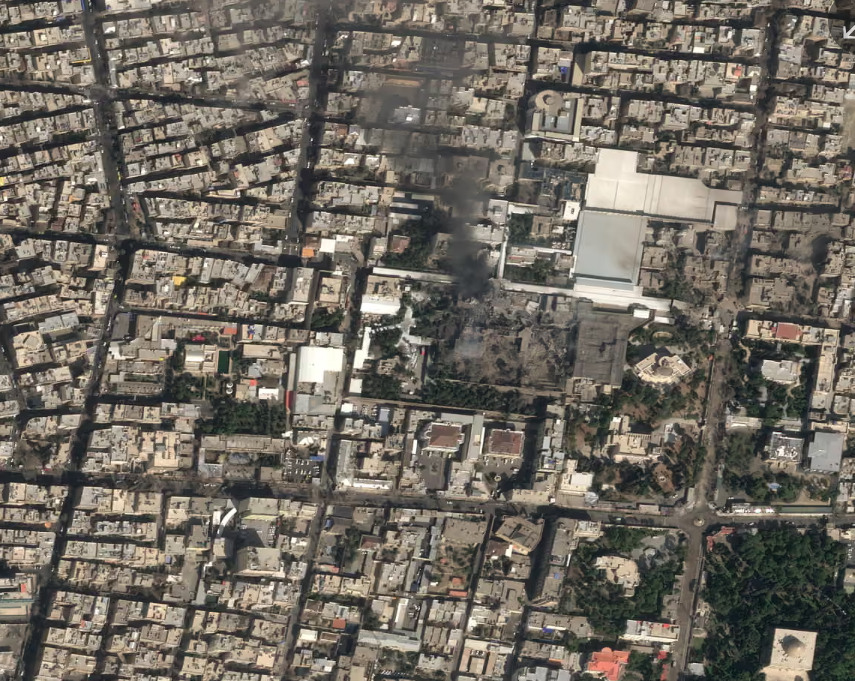
Satellite imagery later showed the compound associated with Khamenei reduced to a vast stretch of grey dust and debris.
A decapitation strike
Israeli officials later described the initial assault as a “decapitation strike” an attempt to simultaneously eliminate Iran’s political leadership and cripple the core apparatus of governance. Such operations aim not just at military installations but at the individuals who command the system.The offensive appeared to extend beyond the sitting leadership. Reports indicated that the Tehran residence of former Iranian president Mahmoud Ahmadinejad was also struck during the operation, though his condition or whereabouts were not immediately confirmed.
Explosions across multiple cities
While Tehran bore the brunt of the initial wave, explosions were reported across several Iranian cities. Attacks were said to have taken place in Qom, Tabriz, Kermanshah, Lorestan, Khorramabad and Karaj, suggesting a nationwide operation targeting strategic infrastructure and political centres.In Tehran, ambulances were seen rushing out of the Pasteur district carrying the injured as emergency services scrambled to respond to the destruction.
Calls for revolt follow strikes targeting Iran’s leadership
At the same time, the first reports of civilian casualties began to emerge. Local authorities said that at least 108 people were killed after an Israeli strike hit a girls’ elementary school in Minab, a city in the southern Iranian province of Hormozgan. One image from the scene showed rescue workers and residents searching through the wreckage, while a man held up a child’s knapsack pulled from the debris.The Islamic Revolutionary Guard Corps has a base in the city, which may have been the intended target. But the timing of the strikes unfolded when people were beginning their day, also increased the chances of civilians being caught in the attack, including children arriving at school and people gathering in public places.If the targeting of Iran’s leadership was not enough to suggest that the US–Israeli strike aimed at regime change, another message soon added to that impression. The Israeli intelligence agency Mossad posted a tweet in Farsi calling for an uprising inside Iran.“Our Iranian brothers and sisters, you are not alone! We have launched a special, super secure Telegram channel for you,” the message read. “Together we will return Iran to its glorious days. Share with us photos and videos of your just struggle against the regime. And most importantly – take care of yourself! We are with you.”The wording from Mossad, openly urging Iranians to rise against their government, was soon echoed by Donald Trump, not in person, but through a recorded message. The recording, made before Washington went to sleep on Friday night, was broadcast on his own Truth Social channel at around 2.30am Washington time, roughly 11am in Tehran.
A moment that could reshape the region
If confirmed, the killing of Iran’s supreme leader would mark one of the most consequential geopolitical events in recent decades — potentially reshaping power dynamics in the Middle East and triggering a chain reaction across the region.For now, however, conflicting claims and limited verifiable information have left the world watching closely as Tehran assesses the damage and prepares its response.