
“I quit engineering in my third year,” writes a 21-year-old: How to rebuild your career path after dropping out


For years, engineering has been sold as a stable, respectable and financially secure choice. In India and abroad, lakhs of students enrol every year believing that the degree itself is a safety net. By the third year, however, some begin to question whether the path they chose at 17 or 18 still makes sense at 21.One such student recently turned to Reddit to share their dilemma. At 21, they have stepped away from mechanical engineering midway through their third year. They are now working a part-time minimum wage job and trying to rebuild direction. In their post, they explained that the coursework felt “too difficult,” internships seemed “impossible to get,” and even graduates they spoke to were struggling. The programme was affecting their health, and, as they put it, “I overall don’t like it.”Since leaving, they have explored healthcare, accounting and business degrees. Each option appears uncertain. They wrote that there is “so much information that is conflicting out there,” especially with constant news about AI, economic slowdown and job competition. What they want is practical: a social career, financial stability of at least $40,000 a year, and room to grow.
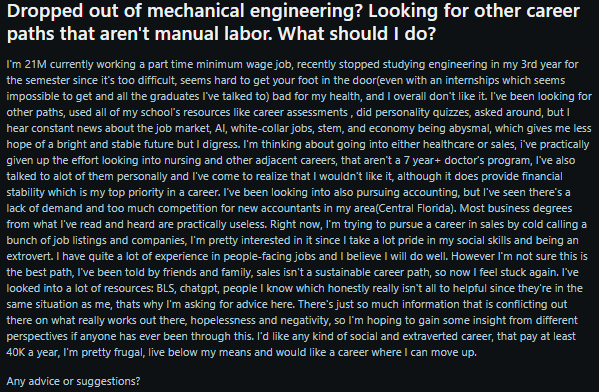
Their post struck a nerve because it reflects a growing student reality. Dropping out is not rare. Feeling lost afterward is even more common.
Step one: Separate emotion from direction
Dropping out often feels like a personal failure. In reality, it is usually a sign of misalignment. By the third year of engineering, students have experienced internships, labs and advanced coursework. Some realise the field does not match their interests, strengths or long-term goals.In this case, the student did not quit impulsively. They used career assessments, personality quizzes and labour data. They spoke to professionals. The confusion did not come from a lack of effort. It came from too many conflicting signals.Rebuilding begins by accepting that leaving a programme is not the end of employability. It is a reset point.
Step two: Evaluate skills, not just degrees
One of the strongest themes in the Reddit responses was about sales. The student mentioned that they take pride in their social skills and are already cold-calling companies. However, friends warned them that sales is not sustainable.A commenter responded, “Your extroverted personality and people skills are actually huge assets in sales.” Another added, “Sales has evolved a ton and can definitely be a solid career path if you’re good with people. SaaS sales, medical device sales, real estate – these can all pay way more than 40k and have clear progression paths.”They pointed out that many technology companies hire entry-level Sales Development Representatives and provide structured training. Their incomplete engineering background could even help them understand technical products better than other candidates.The broader lesson is that career rebuilding should start with identifying usable skills. Communication, technical literacy and confidence are assets. The question is how to apply them in structured roles.
Step three: Consider alternative pathways seriously
Not all advice focused on white-collar careers. One commenter offered a different route: “If college doesn’t seem like its working out, pick a trade and dive in.”They shared that after years as a low voltage technician, they wished they had started earlier. Skilled trades often provide apprenticeship-based entry and steady income progression. They may not carry the same social prestige as engineering, but they offer direct skill-to-income alignment.For students who struggle with academic environments but perform well in practical settings, this option deserves thoughtful evaluation.
Step four: Replace endless research with action
The Reddit post reflects a common pattern. Students spend months analysing industries, reading labour statistics and worrying about long-term disruption. Yet clarity rarely comes from analysis alone.Rebuilding a career path requires defined experimentation. This can include:• Choosing one field and committing to it for a set period• Entering through entry-level roles that provide training• Tracking measurable performance and skill growth• Reviewing progress after gaining experience rather than beforeThe student who wrote the post described themselves as “pretty frugal” and focused on financial stability. That mindset can become an advantage if paired with structured action.
The path forward
“I quit engineering in my third year” sounds dramatic. In practice, many professionals pivot early in their careers. The difference between long-term stagnation and growth lies in what happens next.Dropping out does not automatically reduce opportunity. Failing to build new skills does.For students who see themselves in this Reddit post, the rebuilding process is not about finding a perfect, risk-free career. It is about selecting a direction, developing competence and allowing experience to replace speculation.A degree may close one chapter. It does not close the entire book.