JEE Main 2026 Session 1 answer key out: How to calculate your score and what it means for NITs, IITs and beyond
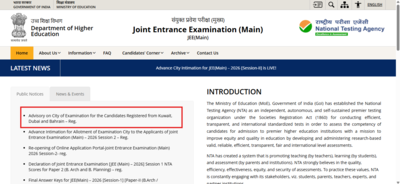
It’s that typical February moment again—the one where lakhs of JEE Main candidates hit the refresh button on the NTA website, their hearts racing with anticipation, calculator at the ready. And February 4, 2026, is no exception. With the National Testing Agency (NTA) releasing the provisional answer key and response sheet for JEE Main 2026 Session 1, candidates finally have their first chance to gauge how they fare—not only in terms of marks but also in terms of their future plans.The answer key has been released for Paper 1 (BE/BTech) and is available on the official website jeemain.nta.nic.in. Alongside this, candidates can also check their recorded responses and, if required, submit objections within a stipulated time period that ends on February 6, 2026, at 11:50 pm.Why the JEE Main answer key matters beyond curiosityFor many students, this is the moment when preparation turns into reflection. The provisional answer key allows candidates to calculate their expected raw score out of 300, long before the knowledge of percentiles or ranks. This early estimate plays a crucial role in deciding whether to go all-in for Session 2, shift focus to JEE Advanced, or start exploring alternative engineering pathways.In simple terms, the answer key is less about validating the past and more about planning the future.JEE Main score calculator 2026: Understanding your probable scoreOnce the answer key and response sheet are in front of you, the next step is calculation. For Paper 1 (BE/BTech), JEE Main follows a clear marking scheme: four marks are awarded for every correct answer, one mark is deducted for every incorrect response, and unattempted questions carry zero marks.
JEE Main score calculator 2026: Step-by-step (this is the part that matters)
Now to the question everyone’s asking: “How much did I actually score?”Step 1: Know the marking schemeFor Paper 1 (BE/BTech):• +4 marks for every correct answer• –1 mark for every incorrect answer• 0 marks for unattempted questions(No negative marking for numerical questions if unattempted.)Step 2: Match answers carefullyOpen your response sheet and the provisional answer key side by side:• Tick correct answers• Cross incorrect ones• Leave unattempted questions asideBe slow and accurate—one miscount can swing your expectations wildly.Step 3: Do the mathUse this simple formula:Estimated JEE Main score = (Correct answers × 4) – (Incorrect answers × 1)That’s it. This gives you your raw score out of 300.Step 4: Interpret the number (career lens)• 220+: Strong NIT/IIIT/IIT (via Advanced) trajectory• 180–220: NITs, top state colleges, serious Advanced prep zone• 140–180: Good GFTIs, private universities, Session 2 improvement scope• Below 140: Time to rethink strategy, strengthen basics, and target Session 2 aggressivelyRemember: percentile comes later, but this score tells you where you stand today.Raising objections: When and how it makes senseIf a candidate believes an answer in the provisional key is incorrect, NTA provides an online mechanism to challenge it. The process involves selecting the question ID, choosing the correct option, uploading supporting academic proof in a single PDF, and paying a non-refundable fee of ?200 per question. All challenges must be submitted online before the February 6 deadline.
How to raise objections:
1. Log in at jeemain.nta.nic.in2. Click “Challenge(s) regarding Answer Key”3. Select the question ID4. Choose the correct option5. Upload supporting proof (single PDF)6. Save your claim7. Pay Rs 200 per question8. Submit and keep confirmationKeep these in mind:• Fee is non-refundable• No objections after Feb 6, 11:50 pm• No individual updates on acceptance/rejection• Final answer key is prepared after expert reviewWhy this phase matters more than you thinkThis answer key isn’t just a scorecard—it’s a career checkpoint.• It helps you decide Session 2 intensity• It shapes JEE Advanced confidence• It informs college shortlisting• It brings emotional closure (or motivation)We have seen students turn average Session 1 scores into stellar Session 2 results—but only when they read the data honestly.The takeaway students often missEvery year, students treat the answer key like a verdict. In reality, it is a diagnostic report. It tells you what worked, what didn’t, and how sharply you need to pivot. Some of the strongest JEE results have come from students who used this exact phase to recalibrate rather than panic.As the dust settles on JEE Main 2026 Session 1, the smartest approach is to calculate carefully, think strategically, and remember that engineering careers are built over years—not decided in one January exam.