Chilling Without Power: The Science of Passive Radiative Cooling Paint for Green Architecture
Modern urban cities are facing a massive energy crisis driven by the rising demand for air conditioning. Traditional cooling systems consume enormous amounts of electricity and release tons of greenhouse gases. Furthermore, the heat dumped outside by air conditioning units makes cities even hotter. This feedback loop is forcing architects and materials scientists to search for zero-energy cooling alternatives. Therefore, green construction firms are adopting a groundbreaking solution. Specifically, they are using passive radiative cooling paint to keep buildings cold without using any power.
This innovative coating reflects almost all incoming solar heat while actively sending internal thermal energy back into deep space.
Exploring the Subatomic Physics of Heat Emission
To understand how a simple paint can cool a building below the surrounding air temperature, we must look at light wavelengths. Traditional white paint reflects some visible light, but it still absorbs a lot of solar energy.
Consequently, the painted surface heats up under direct sunlight.
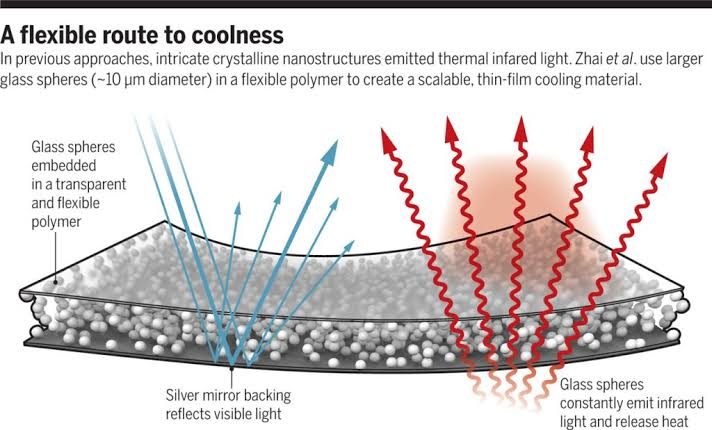
Passive cooling coatings solve this problem by using advanced materials like barium sulfate or silicon dioxide nanoparticles. These particles are carefully sized to scatter and reflect over ninety-five percent of incoming sunlight. However, the real magic lies in how the material handles thermal emission. The paint is engineered to emit heat at a very specific infrared wavelength. This wavelength sits right inside the “atmospheric transmission window.” Because the atmosphere does not absorb this specific light, the heat passes straight through the air and enters the freezing cold of outer space.
Engineering Frameworks for Large-Scale Coating Deployment
Scaling this cooling technology from small laboratory tests to massive commercial buildings requires careful material design. Engineers must address three key structural challenges:
1. Long-Term Durability and Weatherproofing
Rooftop coatings must withstand extreme sun, heavy rain, and freezing winter temperatures without peeling or cracking. Therefore, manufacturers mix the cooling nanoparticles into strong, flexible acrylic polymers. These chemical bases protect the active cooling particles from breaking down. Consequently, the paint maintains its high reflectivity for decades with very little maintenance.
2. Optimizing Particle Size Distributions
If all the particles in the paint are the exact same size, they will only reflect a narrow range of light wavelengths. Therefore, manufacturers use a broad mix of different particle sizes. Smaller particles reflect ultraviolet light, while larger ones scatter visible and near-infrared wavelengths. As a result, the paint blocks the entire spectrum of solar heat, maximizing its cooling power.
3. Enhancing Self-Cleaning Properties
Dust and dirt buildup on a roof can quickly cover the cooling particles and ruin the paint’s performance. To prevent this, developers design the coating to be superhydrophobic, meaning it completely repels water. When it rains, water droplets roll quickly across the surface, picking up and washing away dirt naturally. This self-cleaning action ensures the roof stays bright white and highly efficient.
Building a Greener Urban Infrastructure
As cities adopt these passive cooling coatings, the demand on local electrical grids during hot summer days will drop significantly. Power companies can avoid running expensive, polluting backup power plants during peak hours.
Furthermore, cooling down rooftops helps combat the urban heat island effect, making entire neighborhoods more comfortable. By using the natural cold of outer space, passive cooling paint offers a simple, highly effective path toward sustainable cities.