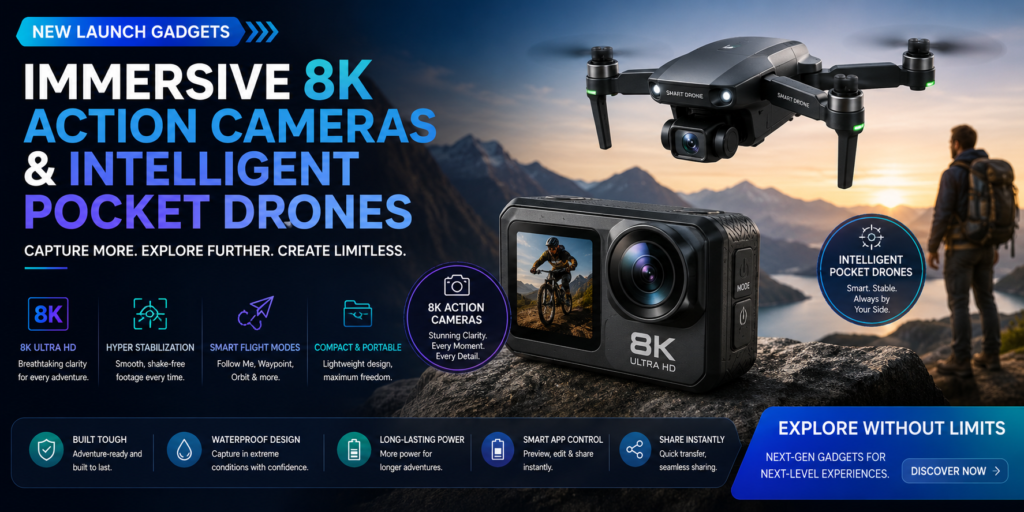
New Launch Gadgets: Immersive 8K Action Cameras and Intelligent Pocket Drones
The international consumer technology marketplace is moving through an incredibly busy production cycle this season. Because adventure filming requirements are growing larger, hardware engineering teams are overhauling optical computing foundations. Therefore, prominent electronics brands are consistently rolling out highly advanced recording devices alongside sophisticated individual mounting gear. Keeping a close eye on these rapid product releases stands right at the Top of the priority list for content creators. Because premium device prices are becoming increasingly competitive, shoppers are eager to track these new launch gadgets to find which investments offer the best daily utility.
In this deep-dive hardware breakdown, we analyze the newest high-performance smart recording devices entering the retail market. Furthermore, we unpack how these modern mobile architectures scale up beautifully to handle complex outdoor routines. If you want to check out previous generational leaps in consumer hardware, you can browse our comprehensive [suspicious link removed] for deeper context. Consequently, let us take a look at the major computational shifts leading the pack this week.
8K Action Cameras: Advanced Local Stabilization Meets Deep Waterproof Enclosures
The most frequently discussed engineering breakthrough within recent loops of new launch gadgets centers on rugged adventure recording tech. While past product cycles depended heavily on standard digital stabilization, current pocket-sized action cameras feature highly localized artificial intelligence processors.
In the Middle of refining these high-performance microchips, development laboratories are dedicating extensive internal space to low-latency frame buffers. For this reason, these cameras handle continuous horizon leveling behind the scenes with minimal battery drainage.
The primary hardware milestones driving this action camera shift include:
- Native 8K Video Sensors: Advanced optical arrays capture stunning landscape details smoothly at sixty frames per second without overheating the frame.
- Hydrophobic Lens Elements: Modern high-density glass coatings repel water droplets instantly during intense surfing or deep diving routines.
- Integrated Voice Editing: Intelligent voice command modules allow users to tag key action highlights verbally while recording completely hands-free.
Additionally, these processing units integrate directly with localized storage layers to safeguard your high-bitrate media files safely. For those interested in studying the official developer toolkits and companion app integration frameworks, you can explore the Android Media Center for structured code guidelines. These premium action rigs are launching later this month across major online marketplaces.
Autonomous Pocket Drones: Overcoming Traditional Controller Constraints
As portable aerial photography tasks continue to grow exponentially, classic manual drone systems are hitting physical usability barriers. To solve this bottleneck, advanced research laboratories are deploying cutting-edge autonomous pocket drones. This shift allows users to project stable flying cameras directly from the palms of their hands.
A side-by-side performance review highlights exactly why hardware designers are shifting toward autonomous spatial flying infrastructure:
| Hardware Engineering Metric | Legacy Manual Drone Systems | Next-Gen Autonomous Pocket Drones |
| Flight Control Interface | Large Multi-Joystick Radio Transmitters | Automated Palm-Launch and Gesture Systems |
| Tracking Sensor Accuracy | Basic GPS Distance Tracking Loops | Real-Time AI Computer Vision Tracking |
| Device Storage Portability | Bulky Carry Cases and Separated Props | Incredibly Slim Foldable Pocket-Friendly Frames |
| System Thermal Management | Exposed External Motor Heat Areas | Distributed Internal Airflow Cooling Paths |
According to independent computing hardware laboratory reviews, transitioning to smart vision chips allows users to capture cinematic angles comfortably. This structural shift eliminates the need for bulky extra items. As a result, manufacturers can design incredibly slim, completely hands-free creative tools for travel vloggers.
Ecosystem Synergy: Creating Fluid Workspace Media Transitions
To ensure that professionals benefit fully from these new launch gadgets, operating system developers are building shared network ecosystems. For example, modern studio environments are utilizing ultra-responsive wireless channels. These connections allow cameras, portable drones, and editing laptops to interact with zero configuration lag.
Major business groups have started deploying unified software platforms that sync active media states across surrounding hardware setups automatically. By tracking local device positions in real time, these systems allow a editor to move an ongoing video project from a camera view to a main laptop terminal instantly. Thus, creative work continues without manual file transfers.
Simultaneously, production facilities are incorporating smart automated sharing protocols. These systems allow primary computers to share excess processing power with secondary mobile displays. This dynamic load balancing allows lightweight tablets to execute intense rendering calculations locally by drawing on the computational strength of a nearby main workstation.
Final Conclusion: Navigating Your Next Major Media Investment
As we bring this modern consumer hardware analysis to a Bottom, the overall developmental trajectory of the consumer market is completely unmistakable. The continuous arrival of new launch gadgets demonstrates clearly that real systemic efficiency relies on a harmonious relationship between tailored physical silicon and smart software development.